There is something especially appealing about an old craft pattern. I’ve collected old patterns for over thirty years and they are not just utilitarian patterns, many of them are little art pieces with the beautiful illustrations and washed colors.
Patterns from the 1960s through the 1990s often have a charm that newer designs do not always capture. You may find cheerful kitchen projects, practical sewing accessories, stuffed animals, fabric ornaments, simple dolls, patchwork pieces, and useful little items that were designed to be made at home.
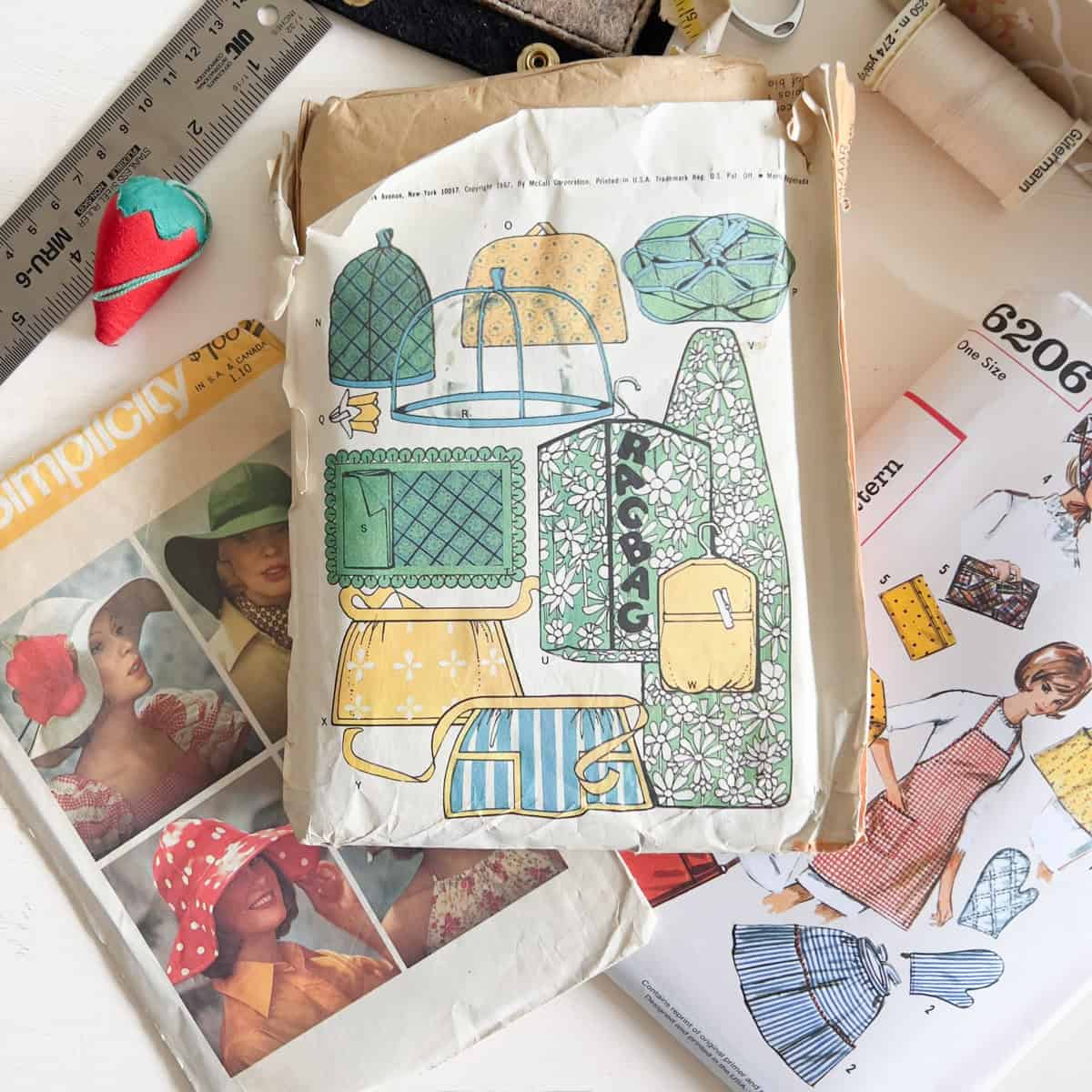
They can also be surprisingly affordable. Vintage patterns often turn up in thrift stores, estate sales, online marketplaces, church rummage sales, and boxes of sewing supplies passed down from relatives.
The trick is knowing which patterns are worth buying, especially when you prefer to sew by hand. Not every vintage pattern is a good candidate for hand sewing. Some were designed around fast machine construction, heavy interfacing, complicated zippers, or long straight seams. Others are almost perfect for hand sewing and may need only a few small adjustments.
Most of these patterns don’t need anything fancy — just a hand sewing kit and a little patience. If the pattern you’re working from calls for a zipper closure, don’t worry, I’ve got a whole tutorial on hand sewing a zipper that walks you through it step by step.
Why Vintage Craft Patterns Are Worth Collecting
Older craft patterns offer more than nostalgia. They can be a wonderful source of ideas, construction methods, and project shapes that are no longer commonly published.
Many vintage patterns were designed for everyday use. You may find patterns for:
- Needle books and sewing cases
- Aprons and kitchen accessories
- Fabric baskets and organizers
- Dolls and stuffed animals
- Christmas ornaments
- Small bags and pouches
- Pot holders and hot pads
- Patchwork projects
- Decorative pillows
- Fabric flowers and home decorations
The instructions may feel a little different from modern tutorials, but the basic sewing skills are often very approachable.
Older craft patterns can also be a good starting point rather than a strict set of rules. You can change the fabric, simplify the construction, adjust the size, or remove details that are not practical for hand sewing.
The Best Decades for Hand-Sewing-Friendly Craft Patterns
Patterns from every decade can be useful, but each period has its own personality.
1960s Patterns
Craft patterns from the 1960s often feature simple shapes, decorative felt work, embroidery, appliqué, stuffed animals, and practical household projects.
Felt projects are especially well suited to hand sewing because the edges do not fray. Many designs can be sewn with a blanket stitch, whip stitch, or small running stitch.
Look for ornaments, soft toys, needle cases, fabric flowers, and simple home decorations.
1970s Patterns
The 1970s were an especially good decade for handmade crafts.
Patterns from this period often include patchwork, appliqué, soft sculpture, fabric baskets, wall hangings, dolls, and country-style home accessories. Hand stitching was frequently part of the design rather than something to hide.
These patterns may use embroidery floss, yarn, felt, cotton fabric, corduroy, denim, or repurposed fabric.
Look for projects with visible stitching, simple patchwork pieces, stuffed shapes, and small household accessories.
1980s Patterns
Craft patterns from the 1980s can be more detailed and decorative. You may find fabric dolls, holiday projects, stuffed animals, padded accessories, baskets, and country-style kitchen décor.
Some of these patterns involve several layers, gathered fabric, lace, ribbon, and decorative trim. They can still work for hand sewing, but it helps to choose projects with smaller pieces and straightforward construction.
Avoid overly elaborate designs unless you enjoy slow, detailed work.
1990s Patterns
Patterns from the 1990s often include practical accessories, quilted bags, simple home décor, holiday crafts, fleece projects, and beginner-friendly sewing patterns.
The construction may rely more heavily on a sewing machine, but many smaller projects can still be adapted.
Look for basic shapes, minimal hardware, and projects that do not require long seams or bulky layers.
What Makes a Vintage Pattern Good for Hand Sewing?
The best patterns for hand sewing usually have a few things in common.
Small Project Pieces
Small pieces are easier to control and quicker to sew by hand. A needle case, ornament, soft toy, or small pouch will usually be more enjoyable than a large tote bag or full-size apron with several yards of seams.
Simple Shapes
Straight lines, gentle curves, and basic geometric pieces are easiest to sew by hand.
Patterns with sharp corners, very tight curves, or complicated gussets may require more patience.
Lightweight or Non-Fraying Fabric
Felt is one of the best materials for adapting vintage patterns because it does not need seam finishing.
Cotton, linen blends, wool felt, lightweight denim, and soft corduroy can also work well. Very slippery fabric, thick upholstery fabric, or fabric that frays heavily may make the project more difficult.
Few Layers
A project made from two layers of fabric is much easier to sew by hand than one that includes batting, interfacing, lining, piping, and heavy trim.
Some layers can be removed or replaced with lighter materials.
Minimal Hardware
Patterns that require long zippers, snaps, metal frames, buckles, or heavy fasteners may be more difficult to adapt.
Buttons, ties, loops, and simple hook-and-loop closures are usually easier to attach by hand.
Decorative Stitching
Patterns that already use blanket stitch, embroidery, appliqué, or visible topstitching are natural choices for hand sewing.
The stitching becomes part of the finished design rather than something that needs to look machine-perfect.
Vintage Patterns That Are Usually Easy to Adapt
Some project types are especially hand-sewing friendly. Ad these types of projects lend themselves to preparing for your handmade holiday plan.
Felt Ornaments
Vintage felt ornament patterns are some of the best patterns to collect.
They are usually made from small pieces, often use simple embroidery stitches, and can be assembled with a blanket stitch or whip stitch.
Needle Books and Sewing Cases
These projects are small, useful, and often made from felt or cotton.
They may include pockets, felt pages, button closures, or embroidery. Most can be completed entirely by hand.
Stuffed Animals and Soft Dolls
Small stuffed animals can be good hand-sewing projects, especially when the pattern uses simple shapes.
Choose designs without complicated joints or extremely small pieces. Sew the seams with a backstitch for extra strength.
Fabric Ornaments and Bowl Fillers
Small stuffed stars, hearts, birds, fruit, and holiday shapes are easy to adapt.
These projects are ideal for using scraps and practicing curved seams.
Simple Pouches
A basic pouch with a flap, drawstring, button, or tie closure can work well.
A zippered pouch is possible to sew by hand, but it may not be the best first project.
Appliqué Projects
Vintage appliqué patterns are excellent for hand sewing.
You can use felt appliqué with a blanket stitch or turn under the edges of cotton appliqué and sew them with a small slip stitch.
Patchwork Projects
Small patchwork projects can be sewn by hand using a running stitch or backstitch.
Look for coasters, pot holders, small mats, ornaments, or simple pillow fronts rather than a large quilt.
Patterns That May Be Difficult to Sew by Hand
Some vintage patterns are better left for machine sewing unless you are prepared to simplify them.
Be cautious with patterns that include:
- Long straps
- Large bags
- Heavy canvas or upholstery fabric
- Thick batting
- Multiple layers of interfacing
- Long zippers
- Piping
- Complicated collars or cuffs
- Very gathered seams
- Large amounts of topstitching
- Heavy-duty hardware
This does not mean you cannot make them. It simply means the project may take much longer and place more stress on your hands.
How to Modify a Machine-Sewn Pattern for Hand Sewing
A vintage pattern does not have to say “hand sewn” to work for hand sewing.
A few changes can make the project much easier.
Use a Stronger Hand Stitch
Replace a machine seam with a small backstitch. Backstitch is strong and works well for stuffed objects, pouches, and seams that need to hold up to regular use.
A running stitch can be used for light-duty seams, basting, gathering, and decorative work.
Increase the Seam Allowance
Some older patterns use narrow seam allowances.
A slightly wider seam allowance can be easier to hold and sew by hand. It also gives you more room if the fabric begins to fray.
Be sure to adjust the finished size if the seam allowance change is significant.
Replace Zippers With Simpler Closures
A zipper can sometimes be replaced with:
- A button and loop
- Fabric ties
- A flap
- A drawstring
- A snap
- Hook-and-loop tape
Choose a closure that suits how the finished project will be used. If you choose to keep the zipper, here is a tutorial on how to sew in a zipper by hand sewing.
Remove Unnecessary Interfacing
Heavy interfacing can make hand sewing difficult.
For a small project, you may be able to use a lighter interfacing, a second layer of cotton, wool felt, or no stabilizer at all.
Finish Raw Edges Simply
Use pinking shears, an overcast stitch, a blanket stitch, or a folded lining to control fraying.
You do not always need to copy the original seam-finishing method.
Divide Long Seams Into Short Sessions
A project with a few longer seams can still be sewn by hand. Mark the seam into smaller sections and work on one area at a time.
This makes the project feel less repetitive and helps keep your stitches even.
What to Check Before Buying a Vintage Pattern
Vintage patterns are not always complete, so it is worth checking carefully before you buy.
Make Sure the Pattern Pieces Are Included
Look at the pattern envelope or instruction sheet and compare the listed pieces with what is inside.
Uncut patterns are wonderful, but cut patterns can still be perfectly usable if all the pieces are present.
Check the Instructions
Missing instructions can make a project much harder to understand.
Some simple patterns are easy to figure out from the pieces alone, but detailed dolls, bags, and stuffed animals may depend heavily on the assembly diagrams.
Look for Damage
Small tears can be repaired, but water damage, mold, heavy odors, or very brittle paper may make the pattern difficult to use.
Check the Finished Size
Some vintage craft projects are much larger or smaller than they appear in the envelope illustration.
Look for finished measurements before deciding whether the project is practical for hand sewing.
Read the Materials List
The materials list will often reveal how complicated the project really is.
A pattern that requires several types of interfacing, foam, cording, plastic canvas, and specialty hardware may involve more work than expected.
Where to Find Vintage Craft Patterns
Vintage patterns can be found in many places, and part of the fun is never knowing what will turn up.
Try looking at:
- Thrift stores
- Estate sales
- Garage sales
- Church rummage sales
- Antique malls
- Used bookstores
- Online marketplaces
- Sewing and craft supply resale groups
- Boxes of family sewing supplies
Do not overlook old craft magazines and pattern booklets. They often contain smaller projects that are easier to hand sew than envelope patterns.
How to Store and Protect Old Patterns
Vintage tissue paper can become fragile, so handle it gently.
Store patterns in acid-free sleeves, large envelopes, or clear document protectors. Keep the pattern pieces with the instructions and original envelope whenever possible.
Avoid folding fragile pieces more than necessary.
For patterns you plan to use, trace the pieces onto tracing paper, freezer paper, or lightweight pattern paper. This protects the original and gives you a working copy that can be altered.
Label the traced pieces with the pattern name, piece number, grainline, cutting instructions, and seam allowance.
Give Yourself Permission to Change the Pattern
Vintage patterns are a starting point.
You do not have to use the suggested colors, fabrics, trim, or construction method. You can reduce the size, enlarge the pieces, remove decorative details, or turn a machine-sewn project into a slow hand-sewn version.
A 1970s wall hanging might become a small appliqué pillow. A 1980s stuffed ornament might become a pincushion. A 1990s zippered bag might work better as a buttoned sewing pouch.
The most useful patterns are often the ones that inspire a new version rather than a perfect reproduction.
Collect what catches your eye, but look closely at how the project is constructed. Small pieces, simple shapes, light fabrics, and visible stitching will usually give you the best results.
And sometimes the best vintage pattern is not the rarest or most valuable one. It is the one you are excited to trace, alter, and stitch by hand at your own pace. Remember some of these beloved patterns have been reissued, so its much easier to cut into a pattern that’s easily replaced!