Some vintage sewing patterns feel almost too precious to use. Even when I buy a pattern because I genuinely want to make it, cutting into decades-old tissue can be difficult, especially when the pattern is complete, uncut and unlikely to be easily replaced.
Simplicity S9496 removes much of that hesitation.
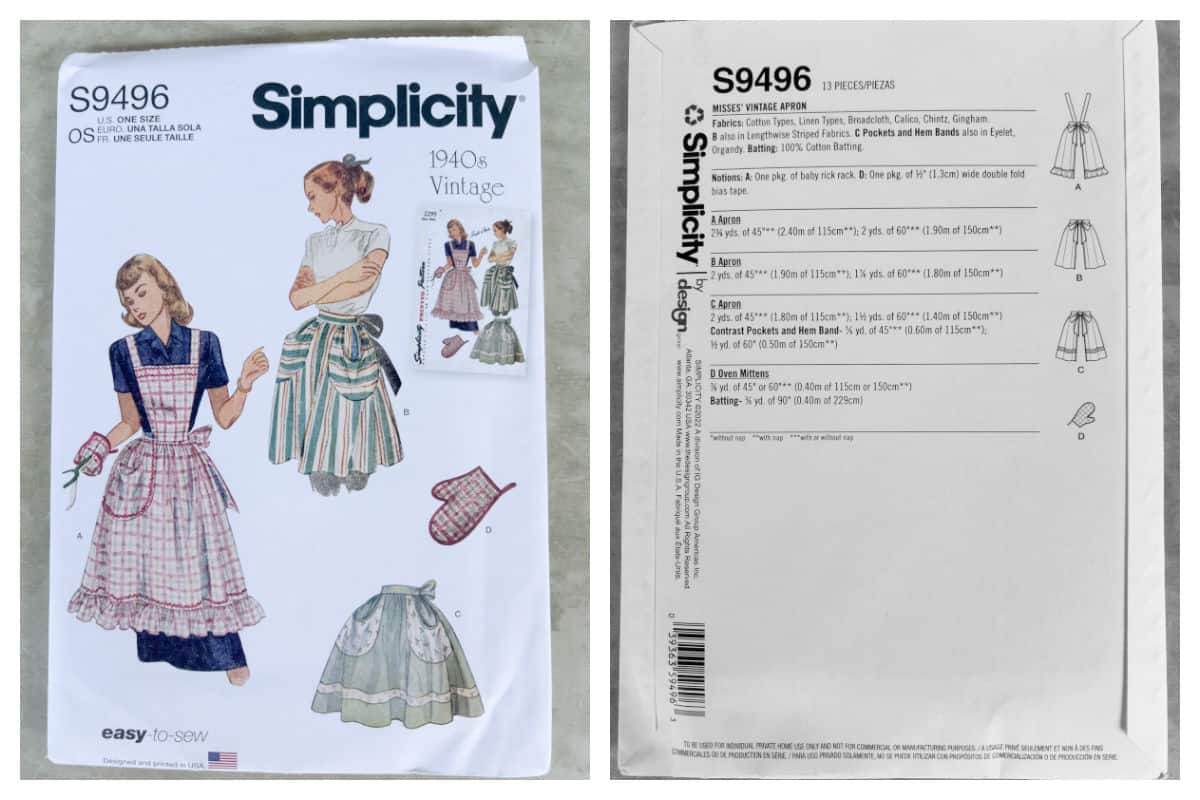
This pattern is a modern reissue of a late-1940s apron design from the Simplicity archives. You still get the charming silhouette, generous pockets and pretty details of the original, but the tissue is new, the instructions are freshly printed and another copy can usually be found without hunting through vintage pattern listings.
For me, that makes it much easier to unfold the pattern, cut into it and actually sew something.
When Was Simplicity 9496 Originally Issued?
The design now sold as Simplicity S9496 was originally released as Simplicity 2295.
The original pattern appeared in the January 1948 Simplicity Fashion Preview, placing it firmly in the late 1940s. Simplicity describes the current version as coming directly from its archives, circa 1948. The design was reissued under the new number S9496 in 2022. (Simplicity)
That date makes sense when you look at the pattern illustration. The full skirts, tied waists, decorative trim and oversized pockets all reflect the practical but feminine apron styles associated with the period.
Although the new envelope simply says “1940s Vintage,” this is not merely a modern pattern inspired by the decade. It is a reproduction of an actual Simplicity apron pattern from 1948.
What Is Included in Simplicity 9496?
Simplicity 9496 includes several coordinated kitchen pieces rather than just one basic apron.
The pattern offers:
- A full apron with a gathered skirt, bib and angled shoulder straps
- A full apron with oversized rounded pockets and decorative trim
- Two variations of a half apron
- A quilted oven mitt
The aprons have gathered skirts attached to fitted waistbands with long ties that fasten into a bow at the back. Depending on the view, you can add rickrack, contrasting fabric, decorative bands or specialty fabric for the pockets.
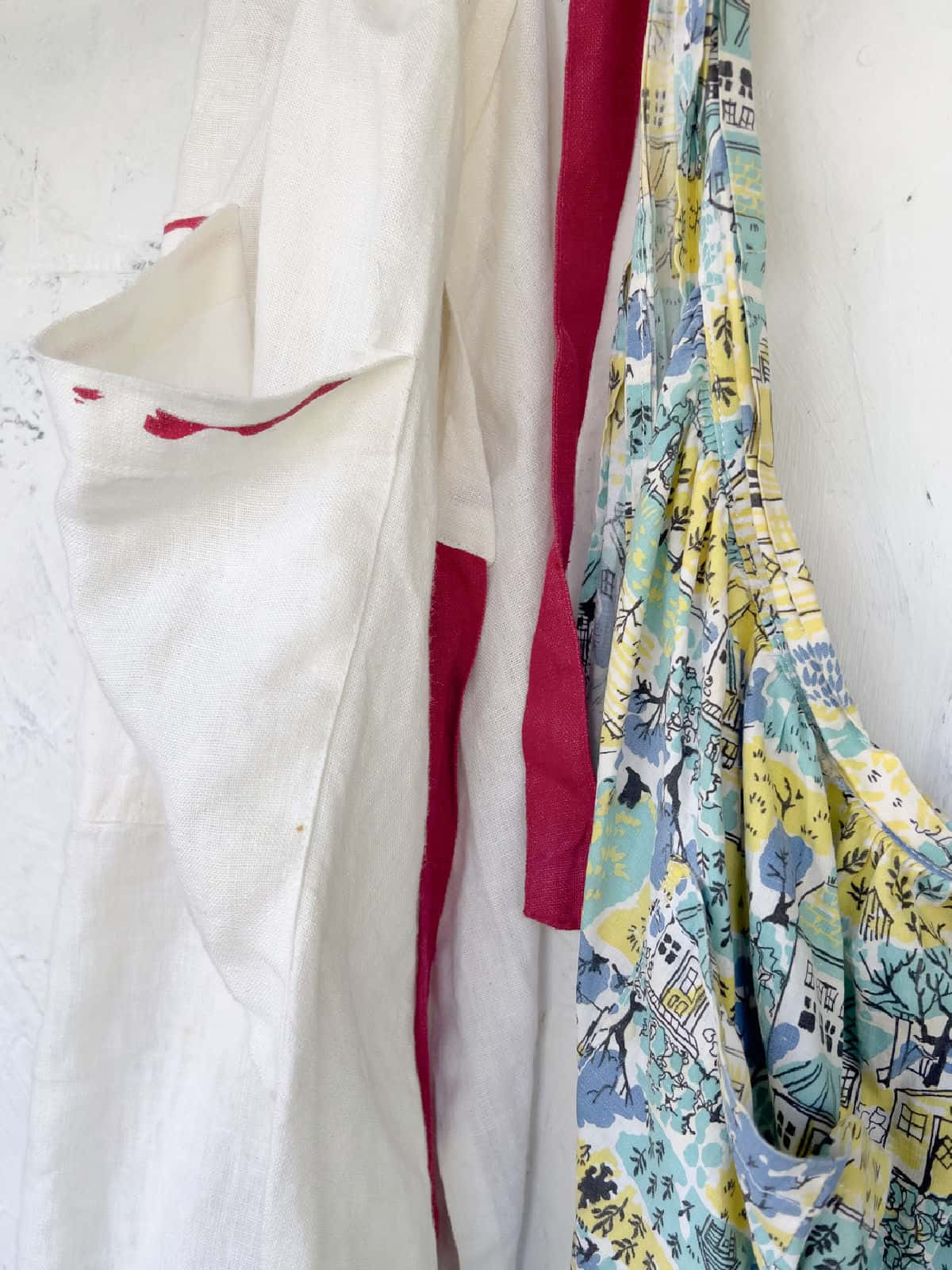
The oversized rounded pockets are one of the best features of the pattern. They are decorative enough to give the apron its vintage look, but they are also genuinely useful.
Simplicity currently rates the pattern as Easy, making it approachable for newer sewists who are comfortable cutting fabric, gathering a skirt and attaching a waistband. (Simplicity)
Suggested Fabrics
The reissued pattern recommends fabrics that are easy to find and well suited to a practical kitchen apron, including:
- Cotton fabrics
- Linen fabrics
- Broadcloth
- Calico
- Chintz
- Gingham
For a first version, I would probably choose quilting cotton, cotton broadcloth or a cotton-linen blend. These fabrics are generally stable, easy to cut and comfortable to sew by either hand or machine.
Gingham would be especially appropriate for the 1940s style. A small floral calico would also work beautifully, particularly with solid-color binding or rickrack.
Fabrics That Would Be Easiest to Hand Sew
For hand sewing, look for a fabric that is tightly woven but not overly heavy.
Good choices include:
- Lightweight quilting cotton
- Cotton broadcloth
- Gingham
- Chambray
- Lightweight linen
- Cotton-linen blends
Very stiff decorator cotton could make the gathered areas bulky. Slippery fabrics, loosely woven linen and delicate organdy may be more challenging for a first hand-sewn version.
A medium-light cotton would provide the easiest balance. It will hold its shape while still allowing a hand needle to pass through comfortably.
Is Simplicity 9496 a Good Pattern for Hand Sewing?
I think Simplicity 9496 is a very good candidate for hand sewing, particularly one of the half aprons.
Aprons are generally forgiving projects because they do not require the precise fit of a blouse, dress or pair of trousers. Most of the construction consists of straight or gently curved seams, hems, gathering, pockets and ties.
Those are all manageable with basic hand stitches.
A hand-sewn version would mainly use:
- Backstitch for strong construction seams
- Running stitch for gathering
- Slip stitch or blind hem stitch for hems
- Whipstitch or overcast stitch for finishing raw edges
- Small hand tacking stitches to hold trim in place
- Catch stitch where a flexible finish is helpful
The waistband and ties would benefit from a firm backstitch because those areas receive the most strain when the apron is tied and worn.
The large pockets could be attached with backstitch, or they could be topstitched by hand with a neat running stitch for a more visibly handmade finish.
Which View Would Be Best to Sew by Hand?
The half aprons would be the easiest place to begin.
They eliminate the bib and shoulder straps, reducing both the number of pattern pieces and the amount of construction. You would still practice several useful skills:
- Gathering fabric
- Making and attaching pockets
- Sewing a waistband
- Turning narrow ties
- Hemming a curved or straight edge
- Adding trim or contrast fabric
The full apron is still possible to sew by hand, but it requires more fabric and additional work around the bib and straps.
The oven mitt is probably the least appealing part to sew entirely by hand. Quilting through several layers can be time-consuming, and a mitt must be securely constructed to remain useful. It could certainly be hand quilted, but I would treat it as a separate project rather than assuming it will be a quick accessory.
Details That May Take Extra Time
Although this is labeled an easy pattern, a few details could slow down a hand-sewn version.
The Gathering
The full skirts contain quite a bit of fabric. Gathering them evenly into the waistband will take patience.
Use two parallel rows of running stitches rather than one. The extra row helps control the gathers and keeps them from twisting while the waistband is attached.
The Pocket Binding
The rounded pockets are one of the most attractive features, but binding a curved edge neatly can be fiddly.
Baste the binding in place before permanently stitching it. Hand basting makes it easier to keep everything smooth around the curve and is one area where hand sewing may actually provide more control than machine sewing.
The Long Waist Ties
Turning long, narrow fabric ties can be tedious. You could avoid some of that work by pressing the edges inward and closing the ties with a slip stitch rather than sewing a tube and turning it.
The Rickrack and Decorative Bands
These details are not structurally difficult, but they require careful positioning. A row of small hand-tacking stitches can secure rickrack neatly without flattening or distorting it.
Why a Reissued Vintage Pattern Is Easier to Use
The availability of this pattern as a new reissue changes the sewing experience.
With an original 1948 pattern, I would be concerned about tearing the tissue, losing a piece or making an alteration that could not be reversed. I might trace every piece before beginning, which is sensible but adds another step between buying the pattern and actually sewing it.
With Simplicity 9496, I would feel far more comfortable cutting directly into the tissue.
The pattern is currently sold as a newly printed paper pattern, and because it is a commercial reissue rather than a rare original, another copy is usually easier to locate.
That does not mean I would be careless with it. I would still press the tissue gently, store the pieces in a larger envelope and label any alterations. But I would not feel as though I were permanently changing a small piece of sewing history.
There is also an advantage for beginner sewists. A newly printed pattern is less fragile than old tissue, and the reproduction uses current pattern labeling and modernized sizing information. Reissued archive patterns are adapted to the brand’s modern size chart rather than being printed exactly in the original vintage sizing.
A Good Bridge Between Vintage Collecting and Everyday Sewing
Simplicity 9496 offers a nice compromise for anyone who enjoys collecting vintage patterns but also wants to use them.
An original copy of Simplicity 2295 would be lovely to own as part of a pattern collection. The reissued S9496, however, may be the better choice for the sewing table.
You can enjoy the original 1948 design without worrying quite so much about damaging old tissue. You can experiment with fabric combinations, change the trim and adjust the pockets without feeling that every decision must be perfect.
Most importantly, you can take the pattern out of the envelope and make something from it.
Would I Hand Sew Simplicity 9496?
Yes, with a little planning.
I would begin with one of the half aprons in a lightweight cotton or gingham. The project would provide enough variety to remain interesting without becoming overwhelming, and the gathered skirt, waistband and large pockets would offer plenty of useful hand-sewing practice.
I might use the sewing machine for the long waistband seams if I wanted to finish more quickly, then complete the pockets, trim and hems by hand. It would also be a good pattern for a hybrid approach in which the basic construction is machine sewn and the visible finishing is completed by hand.
For someone who wants to sew the entire apron by hand, the pattern is still very manageable. It is not a tiny one-evening project, but it is the kind of slow, practical sewing that can be picked up for a little while at a time.
And unlike an irreplaceable original pattern, this is one I would feel comfortable cutting into.