Some vintage patterns capture their decade before you even read the description, and McCall’s 9591 certainly does. The flowing bell sleeves, hip-length blouse, low-slung belts, and dramatically flared pants place it firmly in the late 1960s, even without the handwritten price on the envelope.
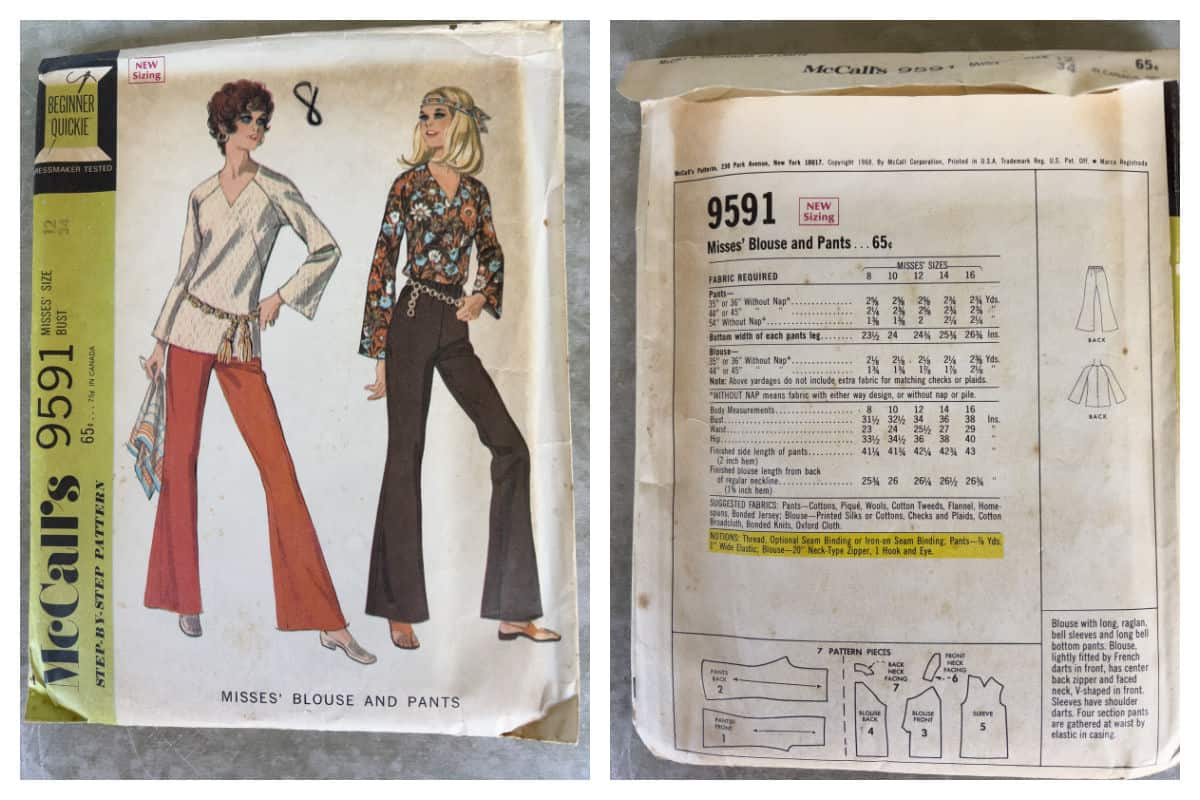
Published in 1968, McCall’s 9591 is a misses’ blouse-and-pants pattern designed as a relatively straightforward coordinated outfit. The blouse has long raglan bell sleeves, a V-shaped neckline, French darts for light shaping, a faced neckline, and a center-back zipper. The four-piece pants have wide bell-bottom legs and an elastic waist casing.
The envelope also labels it a “Beginner Quickie,” which naturally raises an interesting question for those of us who enjoy slower, more traditional sewing:
Could McCall’s 9591 be sewn by hand?
The answer is yes, although one half of the outfit is much better suited to hand sewing than the other. For this reason I’ll focus on just the blouse.
A Closer Look at McCall’s 9591
McCall’s 9591 includes two garments:
- A lightly fitted pullover-style blouse with a back zipper
- Long, elastic-waist pants with dramatically flared legs
The blouse is shaped with French darts in the front rather than multiple fitted seams. Its sleeves are cut in a raglan style and include shoulder darts, while the neckline is finished with a facing. The pants are made from four main sections and gathered at the waist with elastic inside a casing.
Although the fashion illustration gives the outfit a very polished, fitted appearance, the actual construction is simpler than it first seems. There are no shirt cuffs, button plackets, collars, waistbands, or fly-front closures.
That simplicity makes it a particularly appealing vintage pattern for someone interested in trying a hand-sewn garment.
Good Fabrics for the Blouse
For the blouse, I would look for a light-to medium weight woven fabric that drapes without becoming difficult to control.
Good possibilities include:
- Cotton lawn
- Cotton voile
- Broadcloth
- Chambray
- Lightweight linen
- Linen-and-cotton blends
- Rayon challis
- Lightweight crepe
- Soft quilting cotton
A crisp broadcloth or cotton would make the bell sleeves stand away from the arms slightly, creating a shape close to the white blouse shown on the envelope.
A softer rayon, voile, or lightweight crepe would give the blouse more movement and create a drapier, almost peasant-blouse effect.
For a first hand-sewn version, I would choose cotton lawn, chambray, broadcloth, or a lightweight linen blend. These fabrics are generally easier to mark, press, pin, and sew accurately than slippery rayon or crepe.
The Blouse: A Good Hand-Sewing Candidate
The blouse is a strong choice for hand sewing.
Its construction is fairly uncomplicated, and most of the seams are manageable lengths. The front darts, raglan seams, sleeve seams, side seams, neckline facing, zipper, and hem can all be completed using traditional hand stitches.
The blouse would also allow a beginner to practice several useful garment-sewing skills:
- Sewing and pressing darts
- Joining curved raglan seams
- Installing a zipper by hand
- Understitching a facing
- Finishing raw seam allowances
- Hemming bell sleeves
- Working an even garment hem
The bell sleeves are especially helpful because there are no fitted cuffs or sleeve plackets to construct.
I would rate the blouse as very reasonable for an adventurous beginner hand sewer, provided the fabric is stable and easy to handle.
The Pants: Most Likely a NO
The pants could theoretically be sewn by hand, but they would require considerably more time and skill, both are things I don’t have, yet.
Each leg includes long vertical seams, and those seams will be placed under more strain from walking, sitting, and bending. They need to be sewn securely and reinforced appropriately.
The elastic casing is simple, but creating two full-length pant legs by hand involves many feet of stitching. The wide hems will also take time.
For these reason, I would rate the pants as Not Suitable for Hand Sewing:
Best Hand Stitches for This Pattern
A strong backstitch would be the best primary construction stitch for most of McCall’s 9591.
Backstitch
Use backstitch for:
- Blouse side seams
- Sleeve seams
- Raglan seams
Keep the stitches small and consistent.
Running Backstitch
A running backstitch could be used on lower-stress areas of the blouse. It is faster than a full backstitch but stronger than an ordinary running stitch.
Whipstitch or Overcast Stitch
Use one of these stitches to finish raw seam allowances if your fabric frays.
The seam allowances may be finished separately and pressed open, or finished together and pressed to one side.
Slip Stitch
A slip stitch would work well for:
- Securing the neckline facing
- Finishing the sleeve hems
- Finishing the blouse hem
Pickstitch
A hand-worked pickstitch would be a lovely way to install the center-back zipper. It would also suit the period and give the zipper a neat, nearly invisible finish.
The Most Challenging Parts to Sew by Hand
Although this pattern is not overly complicated, a few areas deserve extra attention.
The Center-Back Zipper
A zipper may sound intimidating, but zippers can be beautifully installed by hand. Hand basting first will help keep both sides even.
A pickstitch or small backstitch can then be used to sew the zipper permanently in place.
The Neckline Facing
The facing should lie flat without rolling toward the outside. Careful clipping, grading, pressing, and understitching will make a noticeable difference.
Even when sewing by hand, pressing is part of the construction process. Press each seam as you go rather than waiting until the garment is finished.
Would I Recommend This Pattern for a Beginner Hand Sewer?
I would recommend starting with the blouse rather than the entire outfit.
The blouse offers enough variety to be interesting without requiring an enormous amount of repetitive stitching. It also gives the sewer experience with shaping, a facing, a zipper, and hems.
For a first attempt, I would use a stable cotton or linen blend and avoid very slippery or sheer fabric.
The pants would be a satisfying follow-up project once the blouse is complete. Their construction is not especially advanced, but the amount of hand sewing could feel discouraging to someone making a first garment.
A Few Notes Before You Make It
Vintage pattern sizing is not the same as modern ready-to-wear sizing. Do not choose a pattern based only on the size number printed on the envelope.
For example, surviving copies of McCall’s 9591 include a vintage size 12 with a 34-inch bust and a size 14 with a 36-inch bust.
Measure the pattern pieces and compare them with your own measurements, allowing enough room for movement and wearing ease.
It is also a good idea to make a test version of the blouse in inexpensive fabric before cutting into a special vintage print. Check:
- Bust fit
- Dart placement
- Blouse length
- Sleeve length
- Neckline depth
- Back zipper length
The blouse is shown sitting low on the hips, but it could easily be shortened for a more contemporary fit.
How I Would Make McCall’s 9591 Today
For a wearable version that still honors the original pattern, I would make the blouse in a small floral cotton lawn or lightweight linen.
The blouse would also work beautifully on its own with straight-leg jeans, a long skirt, or simple trousers. That makes it the most versatile portion of the pattern and the one most worth preserving and sewing.
Final Hand-Sewing Verdict
Blouse: Very good candidate for hand sewing
Pants: Not recommended
Best skill level: Confident beginner to intermediate
Best first fabric: Cotton lawn, broadcloth, chambray, or lightweight linen blend
Most useful stitch: Backstitch
Biggest challenge: back zipper
Overall hand-sewing rating: 4 out of 5 for the blouse
McCall’s 9591 is more than a wonderful example of late-1960s fashion. It is also a genuinely usable pattern with relatively simple construction.
For someone interested in connecting vintage pattern collecting with traditional hand sewing, the blouse would be an especially satisfying project: recognizable as vintage, practical enough to wear today, and detailed enough to build real garment-sewing skills.